

Single-Stair Buildings: Technical Design + Baltimore’s Bill 25-0062
A technical guide for architects, engineers, and code officials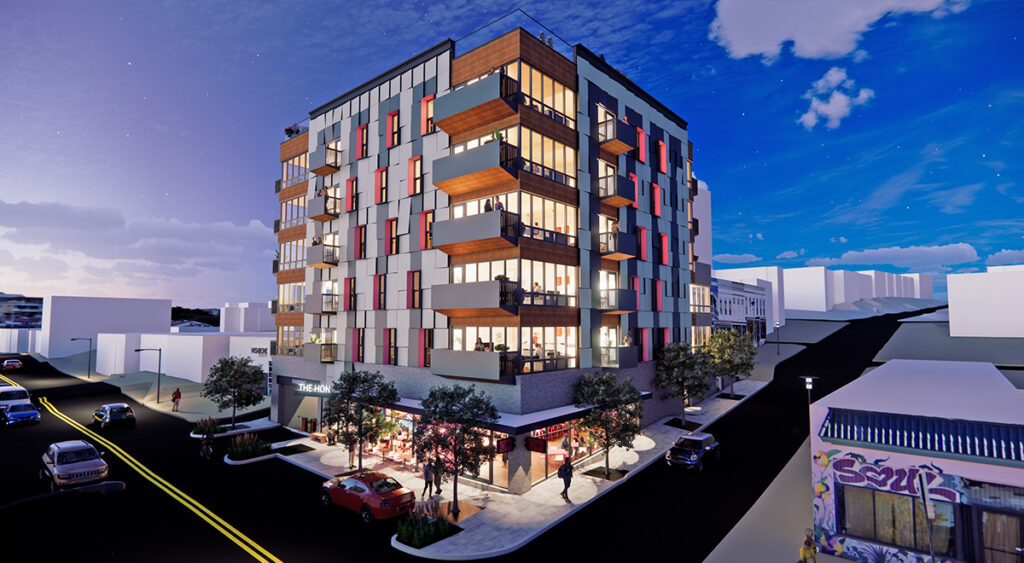 Overview
Single-stair multi-family buildings offer compact cores, improved net-to-gross efficiency, and better daylighting opportunities. Their use has long been restricted in U.S. building codes due to fire/life safety concerns.
Baltimore City Council Bill 25-0062, introduced in May 2025 by City Councilman Ryan Dorsey, proposes amending the Baltimore Building Code to allow single-exit residential buildings under specific, controlled conditions.
Core Design Characteristics
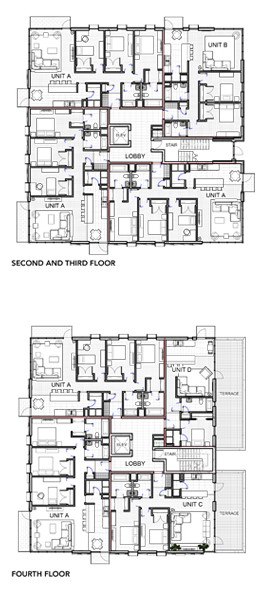
- Central protected stair serving up to 3–4 units per landing.
- Shallow floorplates (30–45 ft / 9–14 m) enable dual-aspect units and cross-ventilation.
- Compact lobby providing separation between units and the stair enclosure.
- Efficient net-to-gross ratio compared to double-loaded corridor typologies.
Bill 25-0062: Baltimore’s Proposed Amendment
Bill 25-0062 introduces a framework for single-exit residential buildings within Baltimore, aligning with international best practices while incorporating strict fire and life safety provisions.
Key Parameters
- Height limits: Up to 6 stories for Type I–IV construction; 4 stories for Type V.
- Occupancy: R-2, maximum of 4 dwelling units per floor.
- Fire protection: 1-hr rated construction, full sprinklers, 2-hr stair enclosure.
- Stair/lobby: Pressurization required; no unit doors directly into stair; max 20 ft from door to stair; 125 ft max travel distance.
- Elevator requirements: Must open to compliant lobbies or be pressurized.
- Roof/street access: Bulkhead or windows required for top-of-stair smoke relief.
Design Implications
Positive Outcomes
- Enables infill housing on small parcels where two cores are impractical.
- Supports dual-aspect units with enhanced daylight and natural ventilation.
- Promotes lower-cost construction while maintaining fire protection standards.
Technical Constraints
- Strict travel distance and door-to-stair limits define plan geometry.
- Pressurization or natural venting must be carefully engineered for smoke control.
- Elevator lobbies require additional fire separation or pressurization strategies.
- Sprinkler design coordination becomes mission-critical to compliance.
Design Practice & Competition Work
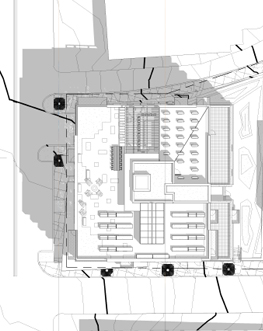
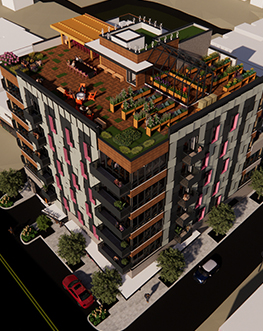
Our team recently explored these principles through the New Urbanism Mid-Atlantic Congress Design Competition, where we proposed a single-stair housing building, named The Hon, for a small underutilized urban parcel. The design emphasized:
- Walkable neighborhood blocks with an infill-friendly footprint.
- Dual-aspect units with generous daylighting and natural ventilation.
- A balance between historic urban fabric scale and contemporary design aesthetics.
This work helped demonstrate that Baltimore’s rowhouse-scale parcels can support multifamily living without defaulting to double-loaded corridors or oversized cores.
Advocacy & Testimony
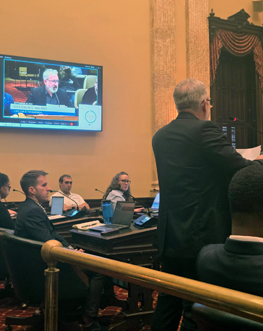
In September 2025, inPLACE Design’s Dustin Watson, testified in support of Bill 25-0062 before the Land Use and Transportation Committee of the Baltimore City Council, representing AIA Baltimore.
His testimony emphasized:
- The bill would propel sustainable development in Baltimore City
- The forward thinking approach would help more projects get completed that otherwise would not be financially viable.
- The safeguards written into the bill—sprinklers, rated enclosures, smoke relief—that maintain a high standard of safety.
As part of AIA Baltimore’s advocacy, Dustin highlighted how the design flexibility unlocked by single-exit provisions can foster equitable, diverse, and sustainable housing typologies in the city.
Debate & Professional Concerns
Supporters (e.g., BaltPOP, Bikemore, local architects and developers) argue this reform will unlock missing-middle housing, citing international precedents with strong safety records.
Critics (including the International Association of Fire Chiefs) emphasize the potential risks of limiting egress redundancy during fire events and challenge the adequacy of enforcement capacity. Community advocates highlight the importance of equitable application and neighborhood-level input.
Professional Takeaway
 For architects and engineers, Bill 25-0062 provides a clear code pathway for single-stair buildings in Baltimore. The prescribed conditions largely align with existing best practices: sprinklers, rated enclosures, smoke-venting, and lobby separation.
As the legislation proceeds through committee, practitioners should:
- Evaluate how single-exit provisions may reshape multifamily prototypes on constrained urban sites.
- Engage in public hearings to advocate for technically feasible, equitable implementation.
- Coordinate early with fire protection engineers and the AHJ to ensure compliant lobby, stair, and elevator design.
Note: This summary is for informational purposes only. Designers must consult the full text of Bill 25-0062, the Baltimore City Building Code, and the Authority Having Jurisdiction before proceeding with design or permitting.